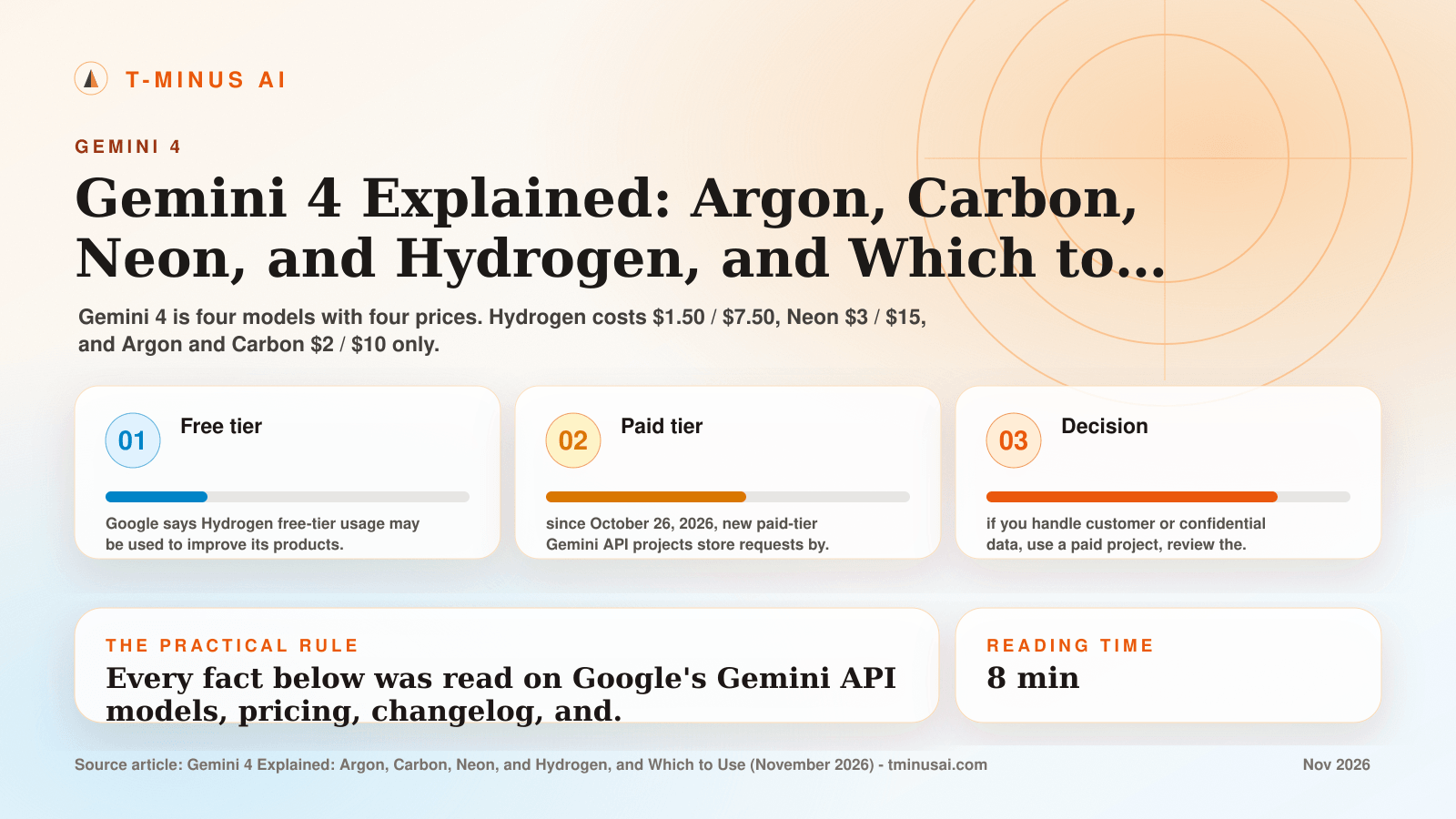
Every fact below was read on Google's Gemini API models, pricing, changelog, and deprecations pages on November 22, 2026. We quote Google's own one-line description of each model and publish no benchmark ranking of our own; leaderboard numbers are labelled "as listed" with a link. All four models have a 1,048,576-token window shared by input and output and a default output of 65,536 tokens, up to 1,048,576 with long decode.
| Model | API ID | Released | Google's description | Input / output per 1M tokens | Free tier |
|---|---|---|---|---|---|
| Gemini 4 Carbon | gemini-4-carbon | November 10, 2026 | Its strongest reasoning model | $2 / $10 through November 30, 2026; $4 / $20 from December 1 | No |
| Gemini 4 Argon | gemini-4-argon | October 13, 2026 | Its efficient frontier reasoning model | Same schedule as Carbon | No (an invite-only Contributor tier lists $1 / $5) |
| Gemini 4 Neon | gemini-4-neon | November 18, 2026 | Frontier-level intelligence with fast end-to-end task completion | $3 / $15 | No |
| Gemini 4 Hydrogen | gemini-4-hydrogen | November 12, 2026 | Everyday coding and agentic workflows | $1.50 / $7.50 | Yes; Google may use free-tier data to improve its products |
| Model | Cached input | Batch or Flex (in / out) | Priority (in / out) |
|---|---|---|---|
| Gemini 4 Carbon | $0.10, then $0.20 from December 1 | $1 / $5, then $2 / $10 | $3.60 / $18, then $7.20 / $36 |
| Gemini 4 Argon | Same as Carbon | Same as Carbon | Same as Carbon |
| Gemini 4 Neon | $0.15 | $1.50 / $7.50 | $5.40 / $27 |
| Gemini 4 Hydrogen | $0.075 | $0.75 / $3.75 | $2.70 / $13.50 |
Cached prices are implicit-cache reads. Google lists Neon with thinking levels low, medium, high (the default), and xhigh, and Hydrogen with levels from low to xhigh. Search grounding includes 5,000 free requests a month shared across Gemini 3 and newer models, then $14 per 1,000.
Which Gemini 4 model should you use?
| Job | Start with | Why |
|---|---|---|
| Everyday coding and agent work | Hydrogen | Google's own description, its default model for the Antigravity agent, and the lowest price at $1.50 / $7.50 |
| Harder coding, analysis, and long tasks | Neon | $3 / $15 with no date-based change; Google pitches it as frontier-level intelligence with fast task completion |
| The hardest reasoning you run | Carbon | Google's strongest reasoning model; worth $4 / $20 from December 1 only if the result repays it |
| Choosing between Argon and Carbon | Carbon, unless your tests say otherwise | Same price and schedule; Carbon ranked above Argon on both leaderboards listed below |
| Free experiments | Hydrogen on the free tier | Google may use free-tier data to improve its products, so send nothing confidential |
| The lowest bill from December 1 | Hydrogen, then Neon | Argon and Carbon double to $4 / $20 on that date |
| Very long documents | Any of the four | All list the same 1,048,576-token shared window |
Worked example: 5 million input and 1 million output tokens a month
Monthly cost is input millions times the input rate plus output millions times the output rate, at standard rates with no caching.
| Model | Input | Output | Total | With Batch (50% off) |
|---|---|---|---|---|
| Hydrogen | 5 × $1.50 = $7.50 | 1 × $7.50 = $7.50 | $15 | $7.50 |
| Argon or Carbon, through November 30, 2026 | 5 × $2 = $10 | 1 × $10 = $10 | $20 | $10 |
| Neon | 5 × $3 = $15 | 1 × $15 = $15 | $30 | $15 |
| Argon or Carbon, from December 1, 2026 | 5 × $4 = $20 | 1 × $20 = $20 | $40 | $20 |
Second check, by ratio: Argon and Carbon at $4 / $20 are exactly twice their own $2 / $10 price, so the $20 month becomes $40. Against Hydrogen, $40 is about 2.7 times $15. Batch halves every row, so Argon or Carbon on Batch from December 1 ($20) still costs more than Hydrogen at standard rates ($15). One more date to know: Gemini 3.8 Flash lists at $0.75 / $3.75 through December 31, 2026 and $1.50 / $7.50 from January 1, 2027, the same rate as Hydrogen, so test Hydrogen against it before then.
What the leaderboards list
As listed on Artificial Analysis on November 22, 2026, its Intelligence Index put Gemini 4 Neon (xhigh) third at 61, Carbon (high) fourth at 60, Hydrogen (xhigh) eighth at 54, and Argon (high) tenth at 50, with listed cost per task of $6.44 for Neon and $7.76 for Carbon. As listed on LMArena's text leaderboard the same day, Carbon (High) was first at 1,527, Argon (High) second at 1,520, and Neon (High) third at 1,513. The two boards order Argon very differently, and each tests specific settings, so treat them as a reason to run your own test, not as a purchase order.
Data terms to read before you send real data
- Free tier: Google says Hydrogen free-tier usage may be used to improve its products, and the same applies to Argon's invite-only Contributor tier.
- Paid tier: since October 26, 2026, new paid-tier Gemini API projects store requests by default (store=true) for generateContent, streamGenerateContent, and batchGenerateContent.
- Decision: if you handle customer or confidential data, use a paid project, review the store setting, and keep free-tier tests to public material.
Other Google changes before December 1
- gemini-2.5-pro and gemini-2.5-flash shut down on December 1, 2026. Requests route to gemini-3.8-flash and gemini-3.5-flash-lite at those models' rates, so the output and the price change. Pin a model on purpose instead.
- gemini-omni-1.1-flash shuts down on December 3, 2026 and routes to gemini-omni-1.2-flash.
- Google's models page tells new projects to use Gemini 4 Hydrogen or Gemini 3.5 Flash-Lite ($0.30 / $2.50).
- In the Gemini app, Google's release notes list "Tasks in Gemini" running on Hydrogen 4 (November 17, 2026) and no default-model or picker change.
Verdict: choose X if
- Choose Gemini 4 Hydrogen if you want the cheapest Gemini 4 model for everyday coding and agent work, and you keep free-tier tests to non-sensitive material.
- Choose Gemini 4 Neon if Hydrogen fails your tests and you want a price that does not change on December 1.
- Choose Gemini 4 Carbon if the task is the hardest reasoning you run and the result repays $4 / $20 from December 1, 2026.
- Choose Gemini 4 Argon only if it is already in production; for new work, Carbon lists at the same price.
- Choose another vendor if you live in Claude Code or Codex: plan limits there matter more than per-token prices.
Compare Gemini 4 with every other current model.
Prices, context windows, and retirement dates with dated vendor sources.
FAQ
How much does Gemini 4 cost?
Per million tokens at standard rates, as listed on November 22, 2026: Hydrogen $1.50 input and $7.50 output, Neon $3 / $15, and Argon and Carbon $2 / $10 through November 30, 2026, then $4 / $20 from December 1, 2026.
What is the difference between Gemini 4 Argon and Carbon?
They share a price and a price schedule. Google describes Argon as its efficient frontier reasoning model (generally available October 13, 2026) and Carbon as its strongest reasoning model (November 10, 2026). As listed on November 22, 2026, Carbon ranked above Argon on both Artificial Analysis (60 against 50) and LMArena (1,527 against 1,520).
Is Gemini 4 free?
Only Hydrogen has a free tier on the Gemini API, and Google says free-tier data may be used to improve its products. Argon, Carbon, and Neon are not on the free tier; Argon also has an invite-only Contributor tier at $1 / $5 that uses data to improve products.
Which Gemini 4 model is the default in Google's tools?
Google lists Gemini 4 Hydrogen as the default for the Antigravity agent, and Tasks in Gemini runs on Hydrogen 4. Google's release notes list no default-model change in the Gemini app.
What happens to gemini-2.5-pro on December 1, 2026?
Google lists it as shut down on December 1, 2026, with requests routed to gemini-3.8-flash at that model's rates. gemini-2.5-flash routes to gemini-3.5-flash-lite on the same date. Test and pin a replacement before then.