All guides
Prompting guideMar 12, 2026

The TminusAI Prompt Scorecard

A practical guide for moving from casual prompt writing to prompt engineering with scoring, diagnosis, adversarial review, and repeatable QA loops.

Series

Guide 4 of 4

Format

PDF • 8 pages

Focus

Prompt Engineering

The TminusAI Prompt Scorecard cover

T-Minus AI

Read the full guide.

High-value AI work is rarely won on the first prompt. It is won through specification, iteration, testing, and structured review.

This guide turns prompting into a quality-control discipline with a five-part scorecard, a repair protocol, an adversarial loop, and reusable templates for immediate use.

The T-Minus AI Axiom

AI reliability is a function of the iteration loop, not the initial ask. A mediocre prompt plus a rigorous QA loop beats a brilliant prompt with no follow-through.

Proof Section

Who this is for, what's inside, and what the pages actually look like

Who This Is For

  • Teams running prompts inside recurring workflows or automations
  • Consultants, researchers, and operators who need predictable outputs
  • Anyone turning prompting into a professional process instead of trial and error

What's Inside

  • The five-dimension Prompt Scorecard and what 8/10 really means
  • A diagnostic protocol for fixing bad prompts instead of retrying blindly
  • The three-step adversarial prompting loop for stress-testing outputs
  • A prompt debugging decision tree for common failure symptoms
  • Ten battle-tested templates that already score 8+
  • The 10-shot consistency test for production-grade prompt stability

Preview Excerpts

See real pages before you download

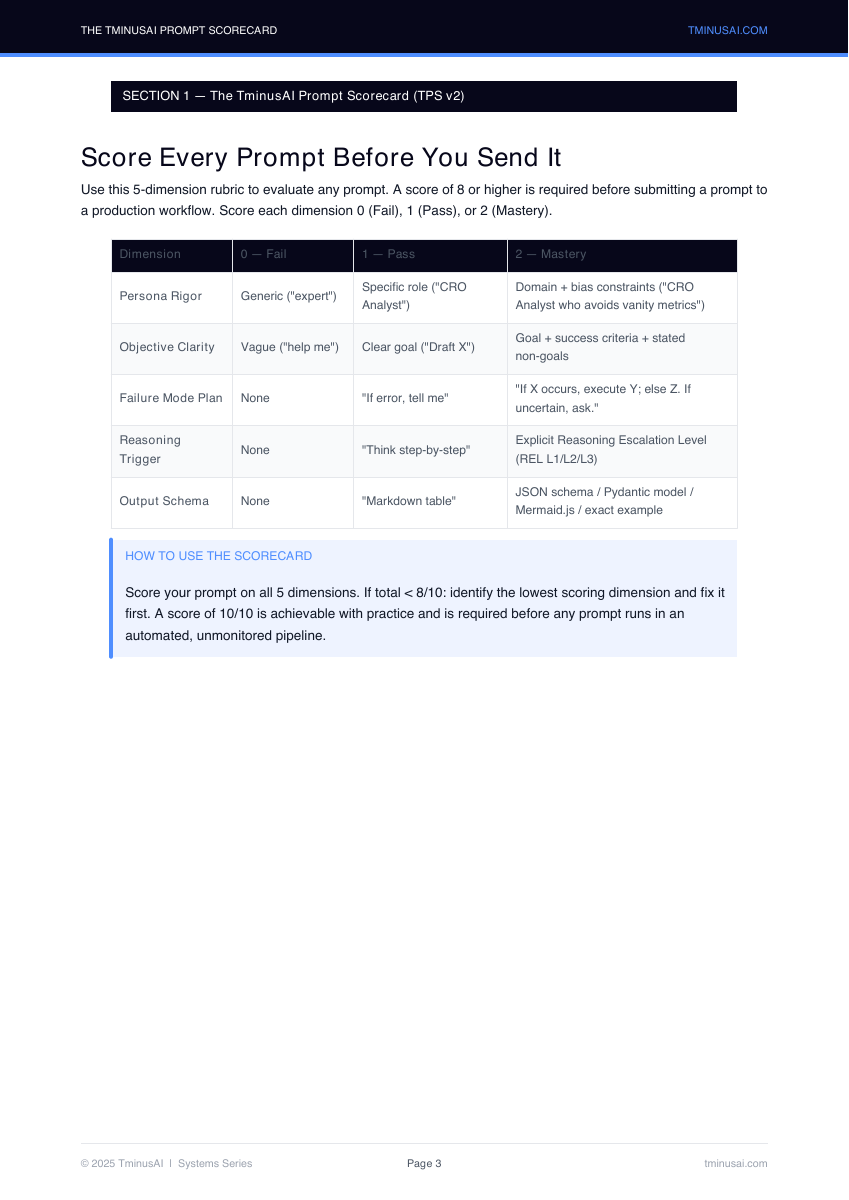
The TminusAI Prompt Scorecard excerpt: Prompt rubric

Slide 1 of 3

Prompt rubric

Score prompts on persona, objective, failure planning, reasoning, and schema before using them.

Inside The Guide

How the material is structured

01

Score prompts before they hit production

Uses five dimensions: persona rigor, objective clarity, failure-mode planning, reasoning trigger, and output schema.

  • Spot weak prompts before they generate expensive noise
  • Push every prompt toward explicit constraints and executable output formats
02

Diagnose failures with targeted fixes

Shows how to repair vague asks, missing schemas, and inconsistent outputs using case studies rather than generic advice.

  • Move from vague retries to specific prompt surgery
  • Add examples, constraints, and context only where the failure requires them
03

Red-team outputs before acting on them

Walks through the adversarial loop, a debugging decision tree, and ten copy-ready templates to keep automated workflows reliable.

  • Stress-test ideas against hostile reviewers before shipping them
  • Run the 10-shot consistency test before any unmonitored automation

Why This Guide Is Worth It

Module 01

Score prompts before they hit production

Uses five dimensions: persona rigor, objective clarity, failure-mode planning, reasoning trigger, and output schema.

Module 02

Diagnose failures with targeted fixes

Shows how to repair vague asks, missing schemas, and inconsistent outputs using case studies rather than generic advice.

Module 03

Red-team outputs before acting on them

Walks through the adversarial loop, a debugging decision tree, and ten copy-ready templates to keep automated workflows reliable.

Download

TminusAI_Guide_4_Prompt_Scorecard.pdf

PDF • 8 pages • 20 KB

8-page PDF with the Prompt Scorecard rubric, failure diagnosis examples, adversarial review loop, debugging tree, and ten ready-to-use templates.

Download file

Next Guide / Related Guides

Keep moving through the systems series

Subscribe To

T-Minus AI

The Systems Dispatch

Weekly AI systems notes, guide drops, and practical workflows built for serious operators.