All guides
OpenClaw guideMar 12, 2026

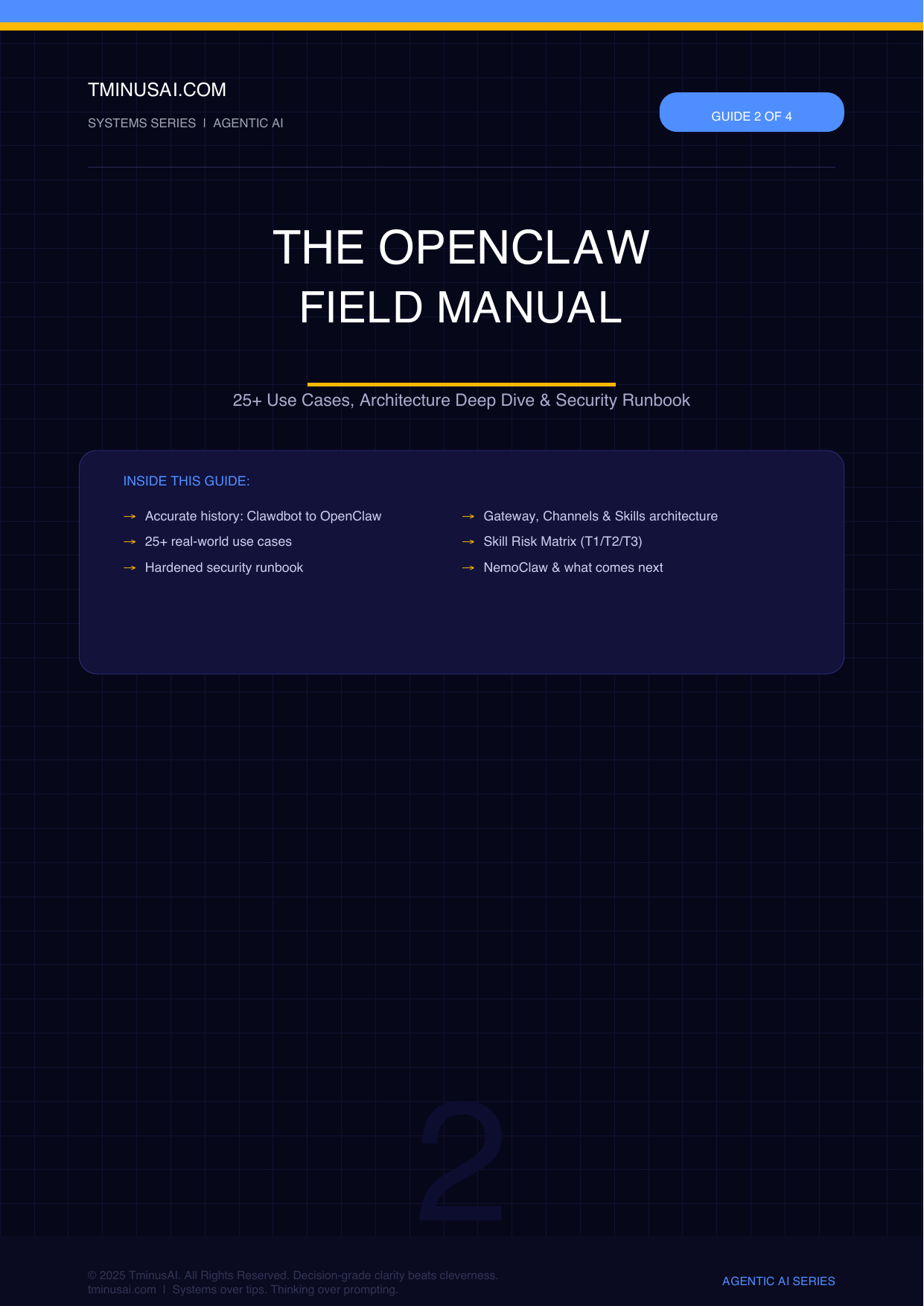
The OpenClaw Field Manual

A field manual for understanding how OpenClaw works, where it is useful, and what security controls are mandatory before you trust it in production.

Series

Guide 2 of 4

Format

PDF • 6 pages

Focus

Agentic AI

The OpenClaw Field Manual cover

T-Minus AI

Read the full guide.

OpenClaw matters because it closes the gap between AI chat and AI action. The real challenge is not novelty; it is deploying an autonomous system without handing it dangerous permissions blindly.

This guide covers the project's verified timeline, the Gateway-Channels-Skills architecture, the practical use cases people are already running, and the security controls that separate a lab toy from a usable agent stack.

The T-Minus AI Axiom

Reliability is built on localized infrastructure, not cloud-based logic. Own your agent stack.

Proof Section

Who this is for, what's inside, and what the pages actually look like

Who This Is For

  • Builders evaluating AI agents beyond simple chatbot wrappers
  • Operators who want real-world OpenClaw use cases before deploying
  • Teams that need security guardrails before granting system access

What's Inside

  • Verified history from Clawdbot to OpenClaw and NemoClaw
  • Gateway, Channels, and Skills architecture explained clearly
  • 25+ real-world productivity, developer, research, and ops use cases
  • T1/T2/T3 skill risk matrix for deciding what is safe to run
  • Zero-trust security runbook for production deployments
  • Model-agnostic deployment guidance across Claude, GPT-5, Gemini, DeepSeek, and local stacks

Preview Excerpts

See real pages before you download

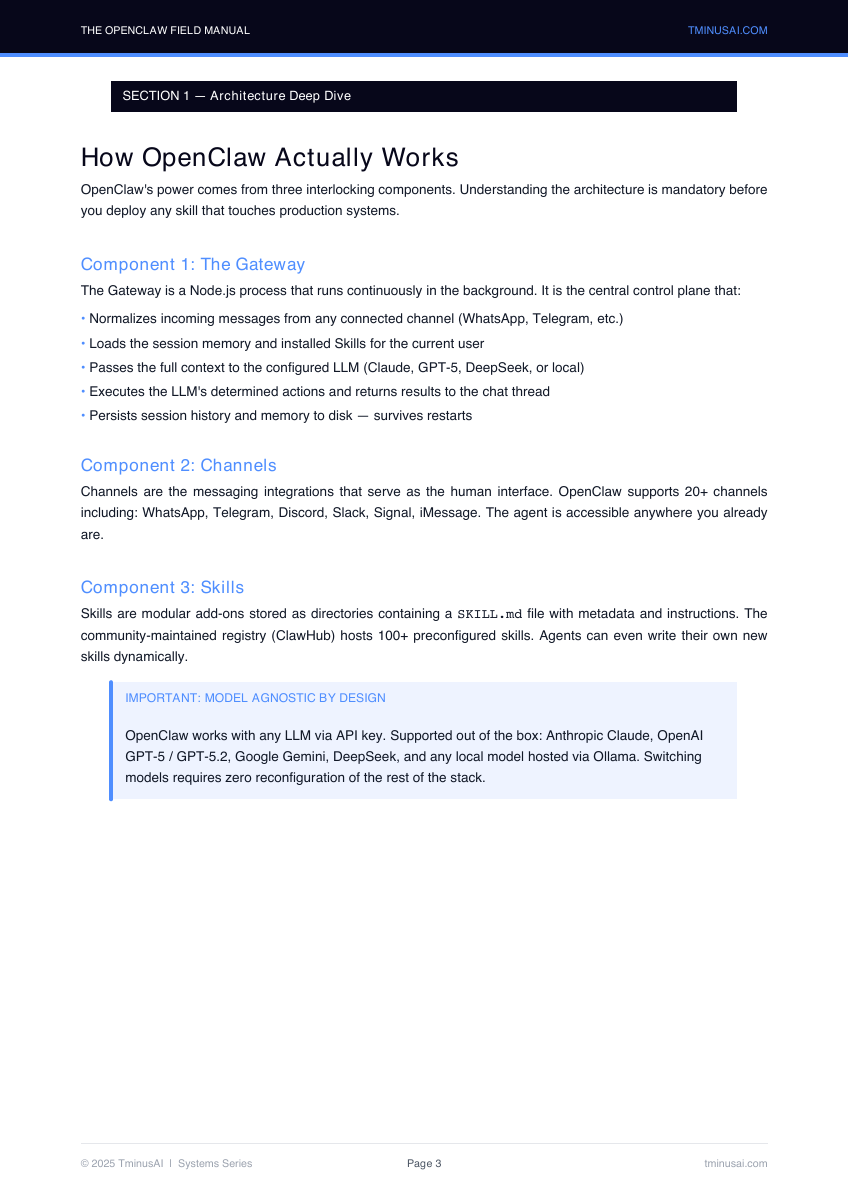
The OpenClaw Field Manual excerpt: Architecture deep dive

Slide 1 of 3

Architecture deep dive

Understand the Gateway, Channels, and Skills layers before deploying anything.

Inside The Guide

How the material is structured

01

Understand the three-part architecture

Explains the Gateway control plane, the channel layer that handles messaging interfaces, and the Skill system that lets the agent extend itself.

  • See how OpenClaw normalizes input, loads memory, calls models, and persists state
  • Understand why model swaps do not require reconfiguring the rest of the stack
02

See what people are actually automating

Catalogs 25+ use cases spanning inbox triage, calendar defense, PR review, research aggregation, contract monitoring, and Raspberry Pi home servers.

  • Use cases are grouped by personal productivity, developer work, research, business ops, and advanced power-user setups
  • Examples stay practical enough to adapt into your own stack immediately
03

Deploy with a zero-trust mindset

Introduces the TminusAI Skill Risk Matrix plus the hardening runbook for loopback binding, secrets management, human approvals, container isolation, injection audits, and logging.

  • Classify every skill before installation
  • Treat shell access and write operations as isolated executive-risk actions

Why This Guide Is Worth It

Module 01

Understand the three-part architecture

Explains the Gateway control plane, the channel layer that handles messaging interfaces, and the Skill system that lets the agent extend itself.

Module 02

See what people are actually automating

Catalogs 25+ use cases spanning inbox triage, calendar defense, PR review, research aggregation, contract monitoring, and Raspberry Pi home servers.

Module 03

Deploy with a zero-trust mindset

Introduces the TminusAI Skill Risk Matrix plus the hardening runbook for loopback binding, secrets management, human approvals, container isolation, injection audits, and logging.

Download

TminusAI_Guide_2_OpenClaw_Field_Manual.pdf

PDF • 6 pages • 18 KB

6-page PDF with the OpenClaw architecture map, skill risk matrix, 25+ use-case catalog, and a hardened security runbook.

Download file

Next Guide / Related Guides

Keep moving through the systems series

Subscribe To

T-Minus AI

The Systems Dispatch

Weekly AI systems notes, guide drops, and practical workflows built for serious operators.